

Feminist Metascience, Risk-Averse Peer Review, & Systems Change Theory

Feminist Metascience
Madeleine Pownall writes about Carolyn Wood Sherif, a pioneer of feminist psychology.

Pownall connects Wood Sherif’s ideas with her own work in the area of feminist metascience:
But while psychology is now in an era of science reform, there are two parallel conversations going on – by those who continue to insist upon reproducibility to strengthen psychological research, and those trying to reform the science as communal, compassionate and open to issues of bias.
Pownall, M. (2027, May 15). My unsung hero of science: Carolyn Wood Sherif, pioneer of feminist psychology who foresaw the risks of scientific bias. The Conversation. https://theconversation.com/my-unsung-hero-of-science-carolyn-wood-sherif-pioneer-of-feminist-psychology-who-foresaw-the-risks-of-scientific-bias-282752
For more work in the area of feminist metascience and its critical approach of “questioning the questions,” see:
Pownall, M. (2025). Teaching feminist psychology epistemology, ontology, and methodology through conceptual replication research proposals. Scholarship of Teaching and Learning in Psychology, 11(3), 499–506. https://doi.org/10.1037/stl0000383
Bennett, E. A. (2021). Open science from a qualitative, feminist perspective: Epistemological dogmas and a call for critical examination. Psychology of Women Quarterly, 45(4), 448-456. https://doi.org/10.1177/03616843211036460
Matsick, J. L., Kruk, M., Oswald, F., & Palmer, L. (2021). Bridging feminist psychology and open science: Feminist tools and shared values inform best practices for science reform. Psychology of Women Quarterly, 45(4), 412-429. https://doi.org/10.1177/03616843211026564
Sabik, N. J., Matsick, J. L., McCormick-Huhn, K., & Cole, E. R. (2021). Bringing an intersectional lens to “open” science: An analysis of representation in the reproducibility project. Psychology of Women Quarterly, 45(4), 475-492. https://doi.org/10.1177/03616843211035678
Risk-Averse Peer Review
Rebekka Brandt offers a nuanced view on the vexed problems of peer review, including a tilt at its reinforcement of methodologism:
Once a methodological template becomes standard, peer review tends to enforce conformity to that template rather than question its scope (Lamont, 2009; Ziman, 2000; Latour & Woolgar, 1979). Reviewers ask whether the study did the right things correctly, not whether it did the right things at all.
This produces a peculiar form of blindness. Entire research programs can become insulated from fundamental critique precisely because they are methodologically well-behaved. Over time, the distinction between “well-executed” and “well-conceived” collapses (Lamont, 2009).
In such environments, peer review functions as a disciplinary reinforcement mechanism. It polices boundaries rather than interrogating assumptions. Novelty is tolerated only if it arrives in familiar form (Ziman, 2000; Latour & Woolgar, 1979).
Brandt concludes that:
The deepest risk facing peer review today is not that it occasionally gets things wrong. It is that it mistakes procedural rigor for epistemic adequacy, and stability for truth. When that happens, science becomes excellent at reproducing what it already believes—and hesitant to confront what it does not yet understand.

Brandt, R. (2026, January 29). The gatekeeping paradox in modern science: Why some breakthroughs are delayed while conservative, but often fragile science is amplified. https://www.academia.edu/158225842/The_Gatekeeping_Paradox_in_Modern_Science_Why_Some_Breakthroughs_Are_Delayed_While_Conservative_But_Often_Fragile_Science_Is_Amplified
Can Systems Change Theory Strengthen Metascience?
Systems change theorists use tools such as concept mapping, social network analysis, and system dynamics modelling. These tools may be useful for addressing the interconnectedness and complexity of the research ecosystem. Hence, in her recent article, Alice Gibson argues that:
Metascience aims to attend to the complex issues that arise in the research ecosystem. [However,] it has yet to adequately heed the potential of utilizing the resources available from the field of systems theory research, which arose out of a recognition of the need to attend to the challenge of complexity.
Gibson, A. (2026). The potential of using resources from systems change theory to strengthen metascience. Insights, 39: 8, 1–8. https://doi.org/10.1629/uksg.738
“10 Years Ago…”
In 2012, John et al. published an influential study on questionable research practices. They found that “the percentage of respondents who have engaged in questionable practices was surprisingly high” (p. 524). In response, 10 years ago, Fiedler and Schwarz (2016) published a follow-up study disputing John et al.’s conclusions. As they explained:
Claims about violations of the standards of good science deserve to be held to the high standards they endorse, not the least in light of the damage that misleading inferences can cause. Unfortunately, one of the more widely cited publications on QRPs in psychological research (John et al., 2012) suffers from ambiguities that prohibit the damning conclusions drawn.
Klaus Fiedler recently passed away at the age of 74. The European Association of Social Psychology’s In Memoriam can be found here.
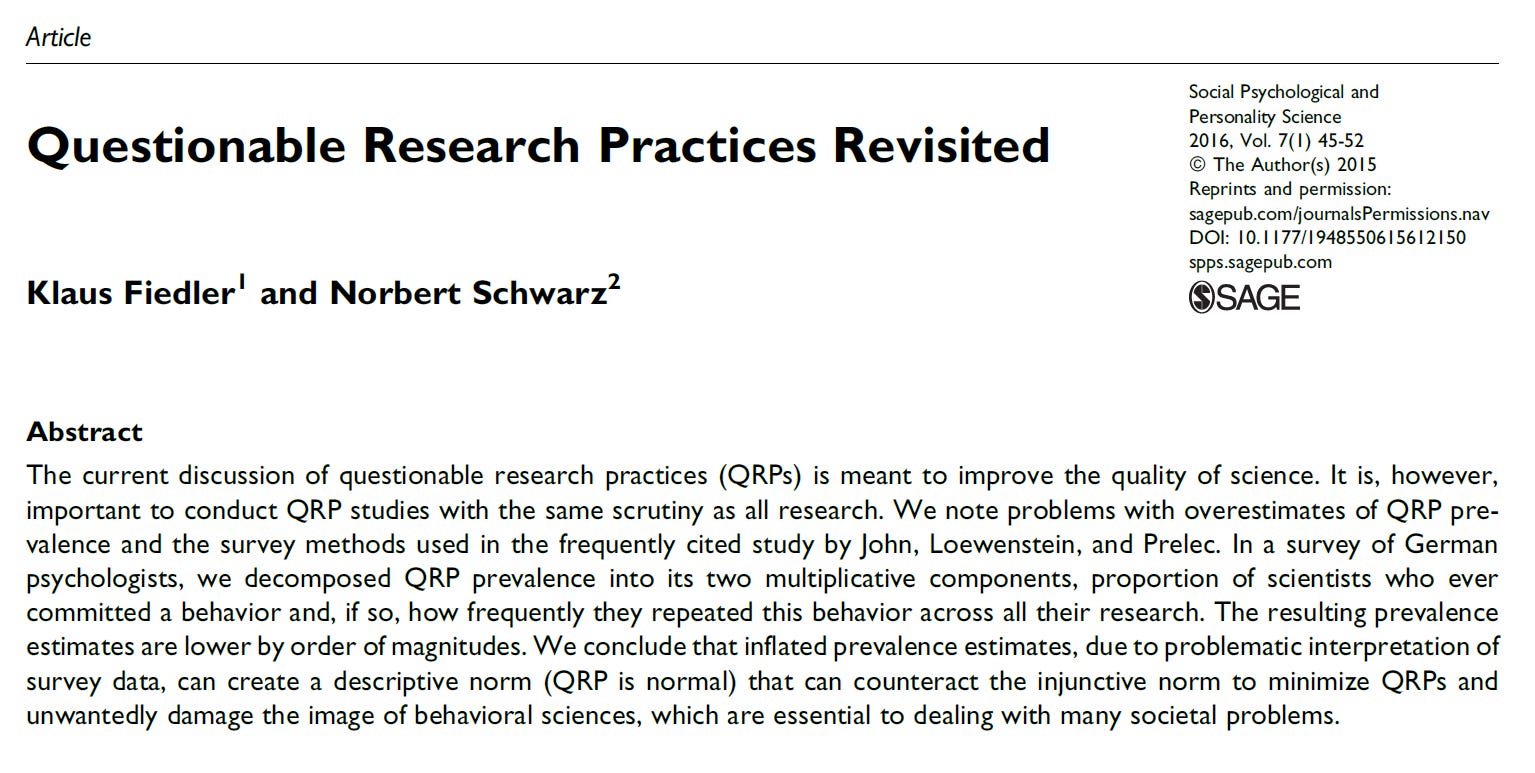
Fiedler, K., & Schwarz, N. (2016). Questionable research practices revisited. Social Psychological and Personality Science, 7(1), 45-52. https://doi.org/10.1177/1948550615612150