

(Re)Conceptualizing Open Science's "Openness"
Addressing Structural Injustice
In her new paper, Sabina Leonelli discusses three forms of structural injustice associated with disparities in scientific research: (1) resource injustice, (2) focus injustice, and (3) labour injustice.
(1) resource injustice [is] grounded on inequity in resourcing research in terms of both human labour and access to relevant tools and infrastructures;
(2) focus injustice [is] grounded on a misalignment between resourcing and the goals that researchers would like to pursue, leading to a redirection on the focus of the research; and
(3) labour injustice [is] grounded on a misalignment between scientific goals and labour conditions, again with repercussions on the choices and methods used for research.
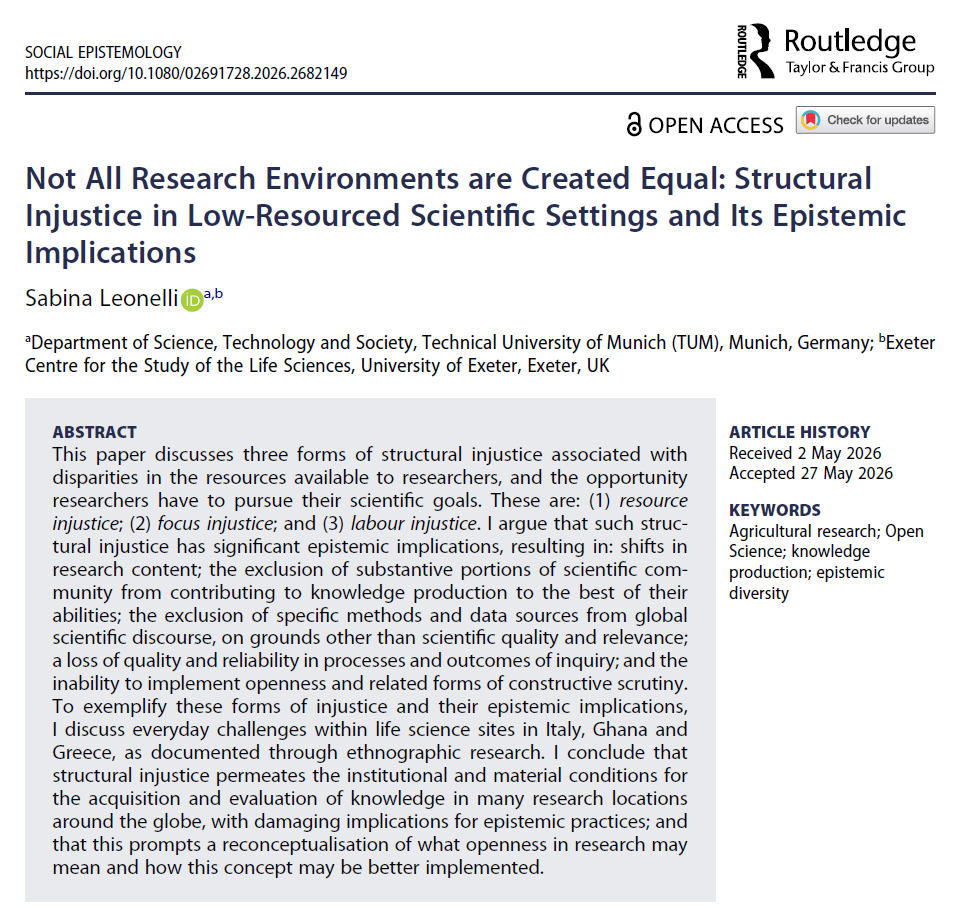
Leonelli (2026) links all three types of structural injustice to open science and argues that they may result in:
ineffective openness, with open science policies and related tools being implemented unsystematically and in ways that discriminate against low-resourced environments, and thus without necessarily increasing the visibility and findability of research carried out in the majority world.
Similar issues have been raised in recent work by Batool Almarzouq (2026), Helen Longino (2026), and Raffaela Kunz (2026), which I covered a few weeks ago.
Leonelli, S. (2026): Not all research environments are created equal: Structural injustice in low-resourced scientific settings and its epistemic implications. Social Epistemology. https://doi.org/10.1080/02691728.2026.2682149
(Re)Conceptualizing the “Openness” of Open Science
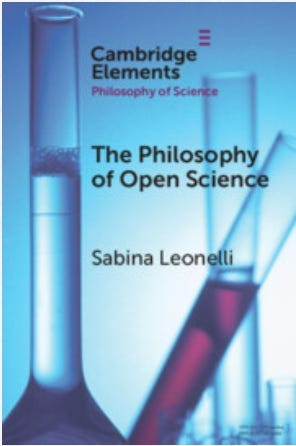
Leonelli (2026) also unpacks her conceptualization of “openness,” which has implications for the ways in which we understand and implement open science. She has previously conceived openness as “judicious connections” with other researchers, rather than as merely sharing research objects such as data and materials (for a summary, see my 2023 post here). As she explained in her 2023 book:
The idea of openness is quintessentially linked to that of learning as going beyond one’s boundaries. This arguably applies to systems of research practice as much as to research groups and individual learners: establishing new connections often means expanding one’s learning, challenging existing assumptions around what is considered external or irrelevant to a given system, and considering whether new boundaries need to be established that incorporate the novel relations.
Establishing new connections with relevant individuals, groups, and systems allow us to see things from different perspectives and identify and interrogate previously unrecognized assumptions. This approach aligns with the view that there is always room for improvement in our conceptual and methodological approach and that others may spot issues we’ve missed.
Leonelli’s (2026) most recent piece reinforces this view by arguing that an “open” science must be a “vulnerable” and incomplete science:
Science does not progress unless researchers look for new ways of knowing, which implies an acknowledgement that current knowledge, methods and instrument are not infallible and can be improved to achieve better results in the future. This is what I take as the most significant meaning of ‘openness’ in research: the awareness that knowledge is never complete and definitive, but rather always exposed to improvement and failure, as well as the challenge to comprehend and interact with an ever-changing world. In this processual understanding of science, scientific methods, norms and institutions cannot ensure 100% safety, trustworthiness and reliability; and fallibility, need and weaknesses (in conceptual as well as material and social resources) are part and parcel of the research effort. Research thus needs to start from an admission of vulnerability, defined in a relational sense as being subjected to one’s environment in ways that limit one’s control.
According to this conceptualization of openness, a genuinely “open” science is one that is “never complete” and always searching for (“open to”) new perspectives and approaches. In social psychological terms, open scientists should have a low need for closure in order to prevent them from seizing and freezing on particular approaches and conclusions (Kruglanski & Webster, 1996).
Scientific “vulnerability” means that we need to concede our limited and incomplete perspectives and accept that we need to seek assistance from others in different environments in order to improve our approach. Hence, open scientists must be open minded to others’ views, approaches, and ways of knowing, and social “connections” are means of accessing these epistemic resources. As Leonelli (2026) explains:
This in turn requires placing social relations and social agency at the heart of scientific practice, emphasising the significance of forging meaningful connections among the humans involved in research efforts – thus facilitating dialogue and exercising judgement about whose needs to prioritise, for which reasons and according to which values – over the quest for efficient technical means to exchange information (Leonelli 2023).
Leonelli’s (2023, 2026) call to forge “meaningful connections” reminds me of Michela Massimi’s (2022) work on perspectival realism:
Making the most of epistemological pluralism in practice involves more than just ensuring that a plurality of epistemologies coexist but self-conscious efforts at dialogue and collaboration across divides.
From this perspective, an attitude of scientific vulnerability and exposure to epistemic diversity should encourage meaningful social connections that lead to higher quality and more transparent research, rather than vice versa.
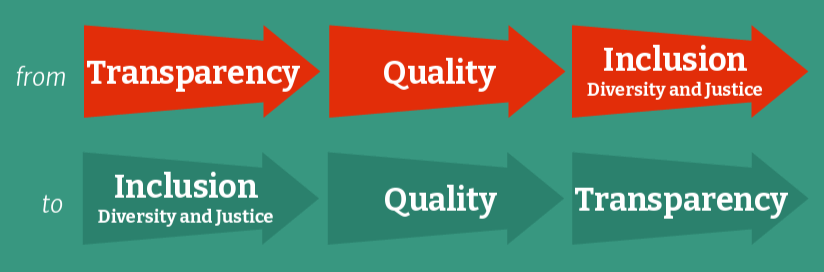
In particular, connecting with researchers who have different approaches should make us question our own approach and motivate a sort of “robustness analysis” across different approaches (see also Massimi, 2022). In this sense, scientific “rigor” and “credibility” come from not only adhering to the methodological norms within our own epistemic communities but also from doubting those norms and exploring beyond our scientific ingroup to seek out the views of other epistemic communities.
Special Issue on Open Science in Social Epistemology
Leonelli’s (2026) article is part of a special issue of the journal Social Epistemology that she edited with Rena Alcalay and Paola Castano as a key output of her European Research Council project on the Philosophy of Open Science for Diverse Research Environments. The special issue will be out as an integrated collection in September.
The full list of articles is as follows:
Ación, L., Ascenzi, L., Calero, A. D., Castaño, P., Formoso, J., Loto, P. A., … Xhardez, V. (2026). More than a NASA badge: Metadocencia and capacity building for open science communities in Latin America. Social Epistemology. https://doi.org/10.1080/02691728.2026.2669558
Alcalay, R., & Vandekerckhove, J. (2026). Epistemic disadvantage in open science practices. Social Epistemology. https://doi.org/10.1080/02691728.2026.2669557
Ankeny, R. A. (2026). How has ‘opening up’ science changed scientific practices? Social Epistemology. https://doi.org/10.1080/02691728.2026.2669568
Lee, C. J. (2026). Critically engaged pragmatism: Scientific norm and social, pragmatist epistemology for AI science evaluation tools. Social Epistemology. https://doi.org/10.1080/02691728.2026.2669578
Leonelli, S. (2026): Not all research environments are created equal: Structural injustice in low-resourced scientific settings and its epistemic implications. Social Epistemology. https://doi.org/10.1080/02691728.2026.2682149
Longino, H. E. (2026): Knowledge and politics: Reflections on challenges to open science. Social Epistemology. https://doi.org/10.1080/02691728.2026.2669576
Sheehan, N. (2026). The sequence and the standard: An account of participatory informational format exclusion (PIFE). Social Epistemology. https://doi.org/10.1080/02691728.2026.2682153
Trappes, R. (2026). Global citizen science as a source of epistemic diversity: The case of eBird India. Social Epistemology. https://doi.org/10.1080/02691728.2026.2669567
Wieber, F., & Hocquet, A. (2026). A portrait of the scientist as a user: Openness and temporality of scientific software. Social Epistemology. https://doi.org/10.1080/02691728.2026.2669573
The Munich Manifesto for Equitable Open Research
Leonelli and others’ work in this area has also recently inspired the Munich Manifesto for Equitable Open Research. A few extracts from the Manifesto follow:
National and international policies tend to implement OR [open research] guidelines, tools and principles in a top-down manner and across domains, with scarce consideration of the diverse capacities, motivations and methods characterising different research communities. Typically, OR tools are produced by the best-resourced research environments, which thereby set the goals that those tools are meant to serve, and define what counts as relevant standards and methods. In consequence, already advantaged contributors end up benefiting disproportionally from OR, which may in turn widen disparities in the research landscape, making some forms of expertise more visible than others regardless of their scientific and societal value.
This has significant consequences for the content and quality of research. Well-documented forms of discrimination and disparities in resources affect which voices are heard, which findings are pursued and recognised, and which methods are considered as best practice. Such divides are compounded by for-profit exploitation of OR initiatives that negatively affect the trustworthiness and sustainability of OR (such as the monetisation of open access publishing or the AI-driven scraping of data shared online), and the failure to reward commercial initiatives committed to enhancing equity within the global research community.
The Manifesto is intended to spur research and policy action on Open Science, with the goal of supporting reliable, responsible, and equitable research worldwide.
You can read and sign the Manifesto here.
I am grateful to Sabina Leonelli for her feedback and suggestions on a draft of this post.


I smell a can of worms opening up. A very old can https://mako.cc/writing/coleman-hill-how_free_became_open.pdf