

There’s a new book out on “Theory and Model Building in Psychology,” edited by Fabian Hutmacher and Alexander Wendt. You can download a copy here.
Looks like a wealth of excellent work here, but, for now, I want to discuss Carlos Cornejo and Pablo Rojas’ chapter on theory aversion, methodolatry, and scientism in psychology. In particular, I want to consider how these issues might relate to what I call phenomenon-first accounts of psychological science (e.g., Lavelle, 2024; Nak et al., 2026) as well as Lakatos’ (1978) concept of naïve methodological falsificationism. I’ll also consider how these issues might affect not only psychology but also metascience.
Theory Aversion
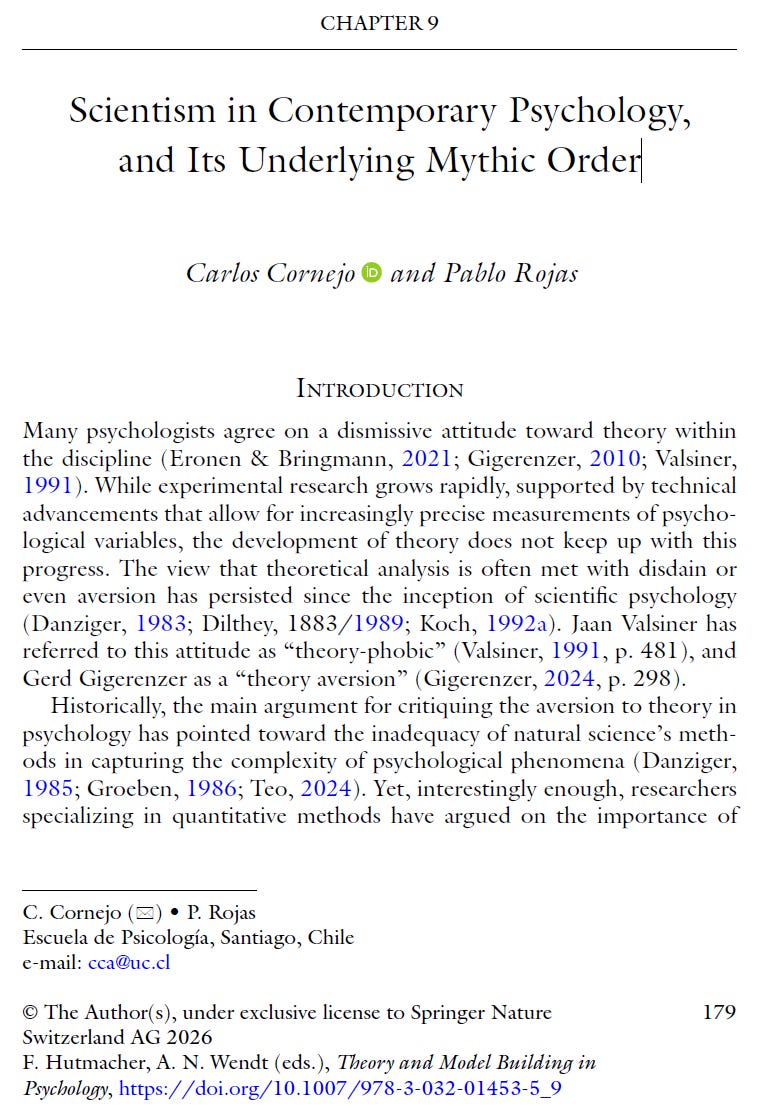
Cornejo and Rojas (2026) argued that contemporary psychology suffers from an aversion to theory, and they set out to understand why.
The view that theoretical analysis is often met with disdain or even aversion has persisted since the inception of scientific psychology (Danziger, 1983; Dilthey, 1883/1989; Koch, 1992a). Jaan Valsiner has referred to this attitude as ‘theory-phobic’ (Valsiner, 1991, p. 481), and Gerd Gigerenzer as a ‘theory aversion’ (Gigerenzer, 2024, p. 298). (p. 179)
This chapter inquires the reasons behind psychology’s theory aversion. (p. 180)
According to the authors, one reason for theory aversion in psychology is that psychologists have not fully embraced Popper’s anti-verificationist philosophy of science. As they explained:
Popper (1935/2002) pointed out the impossibility of verifying a hypothesis by empirical evidence, for singular empirical data can never suffice to uphold a theoretical statement of a general nature. Nonetheless, scientific theories can be falsified by empirical evidence. As a consequence, scientific theories end up being conjectural. What distinguishes scientific knowledge from any other form of knowledge is its permanent proneness to be falsified. These arguments led to the methodological prescription to actively look for evidence that potentially contradicts a held hypothesis. (p. 182)
However, as Cornejo and Rojas (2026) explained:
In psychology, Popper’s philosophy was assimilated only at a methodological level. Psychologists omitted his arguments against verification but adopted his proposal of falsifiability as part of the methodological prescriptions of doing science correctly. Thus, Popper’s scheme of ‘falsification instead of verification’ was replaced by ‘verification + falsification.’ (p. 183)
The Phenomenon-First Approach
In my view, the hybrid “verification + falsification” philosophy may have also influenced a two-stage, phenomenon-first approach in which psychologists are encouraged to: (1) first “establish” that a phenomenon (sometimes called an “effect”) exists before, (2) testing and potentially falsify theories that explain that phenomenon. Lavelle (2024), Nak et al. (2026), and Gal et al. (2026) justify and explain this approach.
Lavelle (2024) argued that:
Psychology needs a greater number of well-established phenomena, and that this step is prerequisite to having well-established theories, formalised or otherwise. These phenomena would come in the form of theory-lite observations of people in their everyday environments. (p. 645)
Similarly, Nak et al. (2026, pp. 5-6) argued that:
Establishing empirical phenomena to explain is an essential step in the scientific process; a step that typically precedes the development of explanatory theories, and can therefore not be cast in the theory-testing mold.
Research methodology for detecting and consolidating empirical phenomena should have a more prominent role in psychological research.
Finally, Gal et al. (2026) proposed a three-stage approach in which
a typical trajectory begins with a striking effect, proceeds to a theory-of-the-effect account of that phenomenon, and only later (if at all) extracts a framework that transcends the original effect paradigm. (pp. 12-13)
Prima facie, the phenomenon-first approach appears to represent theory aversion because it excludes theory when establishing phenomenon and only considers it during a subsequent theory-testing stage. However, this characterization needs some qualification. The phenomenon-first approach does not relegate all theory to the theory-testing stage; it only relegates explanatory theory to this stage. For example, Lavelle’s (2024, p. 645) concept of “theory-lite observation” respects Popper’s view that “observations can never be theory-free” (e.g., Popper, 2002, p. 90). Similarly, Nak et al. (2026, p. 17) accept that theories are inherent in the auxiliary hypotheses that underpin methods as well as the concepts and categories that are used to interpret phenomena.
Hence, the phenomenon-first approach accepts that interpretative or observational theories (Lakatos, 1978, p. 44) are ubiquitous, because they are required to both establish phenomena and test theories. In contrast, it argues that explanatory theories only become involved when testing theories and not when establishing phenomena. Consequently, the phenomenon-first approach can only be said to be “theory-averse” in the sense that it excludes the testing of explanatory theories when establishing phenomena.
Is Explanatory Theory-Testing Absent When Establishing Phenomena?
But is it really the case that tests of explanatory theory are absent when establishing phenomena? Nak et al. (2026) argue that establishing a phenomenon consists of (1) “detecting” (discovering) the phenomenon and then (2) “consolidating” the robustness of the phenomenon vis-à-vis its reliability, validity, and generalizability. In my view, explanatory theory-testing can enter into several of these activities.
First, detecting a phenomenon involves determining whether it is new, interesting, unexpected, and surprising. Consequently, it should not already be adequately explained by extant explanatory theories. After all, if a current explanatory theory provides an adequate explanation of an observed phenomenon, then that phenomenon’s status as “new,” “surprising,” and “unexpected” becomes questionable. Hence, checking whether a phenomenon is genuinely “new” may require determining whether it is already explained by extant explanatory theories. Importantly, this initial step may require testing extant explanatory theories in order to rule them out as potential explanations of the phenomenon.
Second, ruling out issues that might threaten the validity of a phenomenon can also contribute to its explanation. For example, if we rule out demand characteristics as an explanation for a phenomenon (i.e., by testing and tentatively refuting this explanatory theory), then we will have narrowed down the list of potential causal explanations for that phenomenon.
Third, the identification of boundary conditions of a phenomenon is not simply a descriptive exercise; it can help to explain the phenomenon. For example, if we discover that a phenomenon occurs in Western cultures but not in nonWestern cultures (via hypothesis testing), then we have tentatively ruled out causal mechanisms that are not moderated by cultural factors.
Finally, explanatory theory may guide the process of establishing a phenomenon. For example, a tentative explanatory theory of a gender difference in self-esteem may imply that men only have higher self-esteem than women in situations in which they have a higher social status than women. Hence, explanatory theory can help to refine the conceptualization of a phenomenon by generating hypotheses about its boundary conditions. Contrary to this view, Nak et al. (2026) argued that “trying to explain something before knowing whether it actually occurs seems to be a futile exercise” (p. 17). In my view, however, trying to explain a phenomenon before we know whether it exists can help to determine what to look for and where to look for it.
Conversely, excluding explanatory theory when establishing phenomena can contribute to naïve empiricism (Strong, 1991). As van Rooij and Baggio (2021) explained:
Psychological scientists may believe in the need to build large collections of robust, replicable, uncontested effects before even thinking about starting to build theories. The hope is that, by collecting many reliable effects, the empirical foundations are laid on which to build theories... As reasonable as this seems, without a prior theoretical framework to guide the way, collected effects are unlikely to add up and contribute to the growth of knowledge (Anderson, 1990; Cummins, 2000; Newell, 1973). (p. 683)
Hence, without the guiding influence of explanatory theory, attempts to establish phenomena may become directionless, inefficient, and tend towards naïve empiricism (Popper, 2002, p. 88; Strong, 1991).
Phenomenon-first advocates may rightly object that they are not ignoring explanatory theories, they are only delaying their consideration until the theory-testing stage. However, as described above, tests of explanatory theories appear to play a key role in establishing phenomena, and so actively delaying their consideration may lead to a suboptimal establishment process.
Naïve Methodological Falsificationism
Excluding explanatory theories when establishing phenomena represents one form of theory aversion. A second form may involve shielding interpretative theories from criticism when testing explanatory theories. This latter form of theory aversion is symptomatic of what Lakatos (1978) described as naïve methodological falsificationism (p. 42).
Naïve falsificationism prevents criticism of interpretative theories by treating them as “unproblematic” during tests of explanatory theories (Lakatos, 1978, p. 23). This approach allows the explanatory theory to be forced into logical isolation and logical refutation during a theory test (Lakatos, 1978, p. 32). Hence, naïve falsificationism represents a form of theory aversion because it treats interpretative theories as irrefutable background knowledge rather than fallible theories. In contrast, sophisticated methodological falsificationism acknowledges the perpetual fallibility of interpretative theories and, consequently, only results in “anomalies” rather than full-blown logical “refutations” of explanatory theories (Lakatos, 1978, p. 4).
Importantly, unlike naïve falsificationism, sophisticated falsificationism encourages an “appeal procedure” against putative refutations of explanatory theories (Lakatos, 1978, p. 42). During this procedure, a test’s interpretative theory may be specified, criticized, falsified, and replaced. Hence, what may be initially presented as the refutation of an explanatory theory can be challenged and reinterpreted as the refutation of the test’s interpretative theory. As Lakatos (1978) explained:
The theoretician may demand that the experimentalist specify [their] ‘interpretative theory’ and [they] may then replace it - to the experimentalist’s annoyance - by a better one in the light of which [their] originally ‘refuted’ theory may receive positive appraisal. (p. 42)
To illustrate, when faced with a failed direct replication, sophisticated falsificationism allows the consideration of an “independently testable” hidden moderator in the test’s methodology (i.e., generating a new interpretative theory) rather than assuming that the original explanatory theory has been logically refuted (Popper, 1974, p. 986; Rubin, 2025, p. 12). In other words, a failed replication may be provisionally explained by hypothesizing important methodological differences between the original and replication study. In contrast, naïve falsificationism rejects the consideration of hidden moderators on the grounds that they “can be used by critics to question the entire enterprise of direct replication” (Zwaan et al., 2018, p. 46).
As a further illustration, sophisticated falsificationism does not treat a preregistered method as a default position against which to identify and evaluate “deviations” from that method (Rubin, 2020, p. 379). Instead, a preregistered method is regarded as being based on an interpretative theory that may be appealed against, tentatively falsified, and replaced with a better theory. From this perspective, it is the falsified interpretative theory that should be considered a “deviation” from the actual experimental situation.
In summary, psychologists may be theory averse in at least two ways. They may exclude explanatory theory when establishing phenomena, and they may temporarily treat interpretative theory as infallible when testing explanatory theories. In both cases, the problem is that researchers fail to treat relevant theories as fallible objects that are vulnerable to criticism.
Methodolatry
Cornejo and Rojas (2026) also considered the problem of methodolatry in psychology:
The peculiar way in which psychology teaches, applies, and evaluates its methodology has been diagnosed in terms of a “methodolatry” (May, 1969), “method-fetishism” (Koch, 1992a), and a “cult of empiricism” (Toulmin & Leary, 1992).
As Chamberlain (2000) explained, “methodolatry … works to prevent us looking at the assumptions behind our research” (p. 293). Hence, methodolatry deters criticism of a test’s interpretative theory during theory-testing and supports the naïve falsificationist view that a method is “unproblematic” and an appeal procedure is unnecessary.
Of course, all things being equal, rigorous methods are better than non-rigorous methods. In particular, methodological rigor can tentatively reduce what Gustafson and Rice (2020) described as technical uncertainty based on measurement error, modeling approximations, statistical assumptions, and so on. In turn, reductions in technical uncertainty may contribute to reductions in consensus uncertainty (Gustafson & Rice, 2020) about the status of a theoretical explanation. Methodological rigor may even take account of deficient uncertainty or “known unknowns”—the things we know we don’t yet know (Gustafson & Rice, 2020) or what Merton (1987) called “specified ignorance” (i.e., specified but as yet untested hypotheses).
However, no amount of methodological rigor can protect against scientific uncertainty or “unknown unknowns” (Gustafson & Rice, 2020)—the things that we don’t yet know we don’t know (i.e., hypotheses that have yet to be proposed). By definition, this “unanticipated ignorance” (Rheinberger, 2026) cannot be taken into account by our current methods or theories because it can only be specified in the future when it becomes a known unknown. The danger of methodolatry is that it distracts from the fallibility of our methods and the fact that today’s rigorous method may well become tomorrow’s invalid approach.
Moreover, because unknown unknowns are only revealed as known unknowns in the future, a critique of a study’s interpretative theory is likely to be more effective in retrospect, when we have more information to hand, including any unexpected results (Rubin & Donkin, 2024, p. 2031). Hence, in my view, we should not discourage peer reviewers from “critiquing after the results are known” or CARKing (Nosek & Lakens, 2014, p. 138), despite their potentially motivated reasoning, because unexpected results may lead them to generate new, “independently testable,” auxiliary hypotheses (known unknowns) that provide a legitimate challenge to a study’s interpretative theory (Popper, 1974, p. 986; Rheinberger, 2026).
Scientism
Cornejo and Rojas (2026) argued that psychologists are motivated to engage in methodolatry in order to portray psychology as a “real” and “legitimate” science. However, this approach backfires because it results in scientism rather than science (Hayek, 1952). Haack (2012) described six signs of scientism:
Using the words “science,” “scientific,” “scientifically,” “scientist,” etc., honorifically, as generic terms of epistemic praise.
Adopting the manners, the trappings, the technical terminology, etc., of the sciences, irrespective of their real usefulness.
A preoccupation with demarcation, i.e., with drawing a sharp line between genuine science, the real thing, and “pseudo-scientific” imposters.
A corresponding preoccupation with identifying the “scientific method,” presumed to explain how the sciences have been so successful.
Looking to the sciences for answers to questions beyond their scope.
Denying or denigrating the legitimacy or the worth of other kinds of inquiry besides the scientific, or the value of human activities other than inquiry, such as poetry or art.
As Cornejo and Rojas (2026) explained:
One finds similarities between the way psychology has implemented the scientific method and the ritualized form of science called scientism (Hayek, 1952). …. Much of contemporary psychology may be not scientific, but rather scientistic. (p. 188, italics in original)
Methodolatry plays a key role in scientism by reducing the opportunity for critique and appeal:
Science is an activity that supposes and prompts the art of questioning. Yet scientism denies the fallibility of science. …. In this framework the careful replication of inherited methods is held higher than reflecting on their aptness to study the issue at hand. (Cornejo & Rojas, 2026, p. 189)
Again, Cornejo and Rojas’ (2026) depiction of scientism reminds me of naïve methodological falsificationism and its aversion to treating methods as fallible interpretative theories that are vulnerable to appeal.
From Psychology to Metascience
In my view, theory aversion, methodolatry, and scientism may have also moved from psychology into mainstream metascience given that psychologists have had a disproportionate influence in this area (Flis, 2019; Rubin, 2026).
For example, scientism may underlie the demarcationist tendencies that can be found in some methodological reforms. Hence, replicability is “seen as a bright line of demarcation that separates science from non-science” (Zwaan et al., 2018, p. 1), and “in principle, preregistration can establish a bright line between prediction and postdiction …. and preserve accurate calibration of evidence” (Nosek et al., 2018, pp. 2601-2602).
Methodolatry may also be encouraged by preregistration. In particular, preregistration may exacerbate a “researcher commitment bias” (Rubin & Donkin, 2024, p. 2027) that deters the critique of a preregistered method’s underlying interpretative theory. As Rubin and Donkin (2024) explained,
the act of preregistering a research plan may reduce researchers’ potential to deviate from that plan and increase their preference for and commitment to the plan. In turn, these commitment biases may deter researchers from testing alternative post hoc predictions and hypotheses that may provide better explanations of their observed results. (p. 2027)
Finally, some of metascience’s methodological reforms are more aligned with establishing effects than with testing theories (for an alternative view, see Lavelle, 2024, p. 657). As van Rooij and Baggio (2021, p. 683) explained:
Methodological reform so far seems to follow the tradition of focusing on establishing statistical effects, and, arguably, the reform has even been entrenching this bias.
Gal et al. (2026) agree that:
A focus on establishing effects is reflected in recommendations that call for conducting more independent replications of an effect, using large sample sizes, and requiring preregistration.
Finally, a focus on direct replications rather than conceptual replications is more consistent with establishing effects rather than testing theories (see also Crandall & Sherman, 2016).1 Consistent with this view, Nak et al. (2026) observed that:
Few of the replication studies that we know—single-study projects, many-labs, and many-studies projects—speak of reconfirming or falsifying theories based on their result (a notable exception is Coles et al., 2022). Instead, they speak of replicating or failing to replicate effects. In that sense, the turn towards open science and reproducibility already embodies a significant shift towards phenomena-oriented research, and many of the methodological innovations that have been implemented in the wake of the reproducibility crisis are best cast in that way. (p. 9)
More generally, Cornejo and Rojas’ (2026) concerns about psychology’s (a) “methodolatry,” (b) “use of statistics as a fix-all,” (c) “ontological belief that there is a ‘world of facts’ susceptible to be objectively and neutrally described,” and (d) “cult of empiricism” match some of my own concerns about mainstream metascience’s theory of science. For example, in Rubin (2023), I argued that some aspects of mainstream metascience contain elements of:
1. predictivism: the view that a priori predictions are superior to post hoc inferences (Oberauer & Lewandowsky, 2019, p. 1605; Rubin, 2017b, 2022);
2. methodolatory/methodologism: the prioritizing of methodological rigor over other research concerns, such as theory (Chamberlain, 2000; Danziger, 1990, p. 5; Gao, 2014);
3. statisticism/mathematistry: an overemphasis on statistics as both a problem and a solution in science (Boring, 1919; Brower, 1949; Fiedler, 2018; Proulx & Morey, 2021);
4. naïve empiricism (Strong, 1991): the view that science progresses through the accumulation of replicable effects (Flis, 2022; Proulx & Morey, 2021; van Rooij & Baggio, 2021);
5. naïve objectivism: the view that it is possible for scientists to adopt unbiased and objective perspectives (Field & Derksen, 2021; Penders, 2022; Wiggins & Christopherson, 2019)
Of course, not all of these issues are applicable to all of metascience, given the diversity of approaches that exist in this field. However, each issue has been raised as a potential concern in the general case (which is itself a fallible theory of modern mainstream metascience).
Conclusion
Theory aversion may pose problems in both psychology and metascience. In particular, the exclusion of explanatory theory when establishing phenomena may lead to naïve empiricism, and the shielding of interpretative theory from criticism when testing theories may lead to naïve falsificationism.
In my view, we should acknowledge the primacy of fallible theory throughout all stages of scientific investigation. Contra scientism and methodolatry, no scientific method, phenomenon, or theory can ever be sufficiently “established” to evade criticism, even temporarily.
References
Burgos, J. E. (2024). Getting ontologically serious about the replication crisis in psychology. Journal of Theoretical and Philosophical Psychology, 45(2), 79–100. https://doi.org/10.1037/teo0000281
Chamberlain, K. (2000). Methodolatry and qualitative health research. Journal of Health Psychology, 5(3), 285-296. https://doi.org/10.1177/135910530000500306
Cornejo, C., & Rojas, P. (2026). Scientism in contemporary psychology, and its underlying mythic order. In F. Hutmacher & A. N. Wendt (Eds), Theory and model building in psychology. Palgrave Macmillan. https://doi.org/10.1007/978-3-032-01453-5_9
Crandall, C. S., & Sherman, J. W. (2016). On the scientific superiority of conceptual replications for scientific progress. Journal of Experimental Social Psychology, 66, 93-99. https://doi.org/10.1016/j.jesp.2015.10.002
Flis, I. (2019). Psychologists psychologizing scientific psychology: An epistemological reading of the replication crisis. Theory & Psychology, 29(2), 158-181. https://doi.org/10.1177/0959354319835322
Gal, D., Calder, B., & Sternthal, B. (2026). Three strategies for claiming research progress. Journal of Consumer Psychology, 00, 1–18. https://doi.org/10.1002/jcpy.70033
Gustafson, A., & Rice, R. E. (2020). A review of the effects of uncertainty in public science communication. Public Understanding of Science, 29(6), 614-633. https://doi.org/10.1177/0963662520942122
Haack, S. (2012). Six signs of scientism. Logos & Episteme, 3(1), 75-95. https://doi.org/10.5840/logos-episteme20123151
Haig, B. D. (2022). Understanding replication in a way that is true to science. Review of General Psychology, 26(2), 224-240. https://doi.org/10.1177/10892680211046514
Hayek, E. A. (1952). The counter-revolution of science. Free Press.
Lakatos, I. (1978). The methodology of scientific research programmes (Philosophical Papers, Volume I). Cambridge University Press.
Lavelle, J. S. (2024). Less theory, more observation: A response to psychology’s ‘theory crisis’. Philosophy, 99(4):639-665. https://doi.org/10.1017/S0031819124000202
Merton, R. K. (1987). Three fragments from a sociologist's notebooks: Establishing the phenomenon, specified ignorance, and strategic research materials. Annual Review of Sociology, 13(1), 1-29. https://doi.org/10.1146/annurev.so.13.080187.000245
Nak, J., van Dongen, N. N. N., Woodward, J. F., Scheel, A. M., Haig, B., van Bork, R., … Borsboom, D. (2026). Establishing psychological phenomena: An alternative methodological perspective on scientific practice. PsyArXiv. https://doi.org/10.31234/osf.io/rh9cu_v1
Nosek, B. A., Ebersole, C. R., DeHaven, A. C., & Mellor, D. T. (2018). The preregistration revolution. Proceedings of the National Academy of Sciences, 115, 2600-2606. http://dx.doi.org/10.1073/pnas.1708274114
Nosek, B. A., & Lakens, D. (2014). Registered reports: A method to increase the credibility of published results [Editorial]. Social Psychology, 45(3), 137–141. https://doi.org/10.1027/1864-9335/a000192
Popper, K. R. (1974). Reply to my critics. In P. A. Schilpp (Ed.), The philosophy of Karl Popper (Book II) (pp. 960-1197). Open Court.
Popper, K. R. (2002). The logic of scientific discovery. Routledge.
Rao, K. R. (1981). On the question of replication. Journal of Parapsychology, 45(4), 311. https://www.proquest.com/scholarly-journals/on-question-replication/docview/1292177160/se-2
Rheinberger, H. J. (2026). Ignorance and error are at the heart of scientific knowledge production. In A. Karakas & A. T. Tuboly (Eds), Scientific mistakes and mistaken science. Springer. https://doi.org/10.1007/978-3-032-25925-7_6
Rubin, M. (2020). Does preregistration improve the credibility of research findings? The Quantitative Methods for Psychology, 16(4), 376–390. https://doi.org/10.20982/tqmp.16.4.p376
Rubin, M. (2023). Questionable metascience practices. Journal of Trial and Error, 4(1), 5–20. https://doi.org/10.36850/mr4
Rubin, M. (2025). The replication crisis is less of a “crisis” in Lakatos’ philosophy of science than it is in Popper’s. European Journal for Philosophy of Science, 15(5). https://doi.org/10.1007/s13194-024-00629-x
Rubin, M. (2026). What is critical metascience and why is it important? Frontiers in Psychology, 17:1860740. https://doi.org/10.3389/fpsyg.2026.1860740
Rubin, M., & Donkin, C. (2024). Exploratory hypothesis tests can be more compelling than confirmatory hypothesis tests. Philosophical Psychology, 37(8), 2019−2047. https://doi.org/10.1080/09515089.2022.2113771
Strong, S. R. (1991). Theory-driven science and naïve empiricism in counseling psychology. Journal of Counseling Psychology, 38(2), 204–210. https://doi.org/10.1037/0022-0167.38.2.204
van Rooij, I., & Baggio, G. (2021). Theory before the test: How to build high-verisimilitude explanatory theories in psychological science. Perspectives on Psychological Science, 16(4), 682-697. https://doi.org/10.1177/1745691620970604
Zwaan, R. A., Etz, A., Lucas, R. E., & Donnellan, M. B. (2018). Making replication mainstream. Behavioral and Brain Sciences, 41, e120. https://doi.org/10.1017/S0140525X17001972
Citation
Rubin, M. (2026). Theory aversion, methodolatry, and scientism in psychology and metascience: Comment on Cornejo and Rojas (2026). Critical Metascience. https://doi.org/10.59350/86y7r-7ca63

On some readings, establishing effects via direct replications is considered to be consistent with Popper’s requirement that effects should be “reproducible.” For example, in their article “Making Replication Mainstream,” Zwaan et al. (2018) explained:
Popper (1959/2002) noted that an “effect” that has been found once but cannot be reproduced does not qualify as a scientific discovery. (p. 2)
However, Popper’s “reproducibility” criterion does not imply that effects must be replicated to be established. For Popper, a “reproducible effect” is one that is “inter-subjectively testable” (Popper, 2002, pp. 23, 43, 66). Specifically, it refers to a “low-level empirical hypothesis” that can, “in principle,” be tested by anyone (Popper, 2002, pp. 23, 66–67). Importantly, however, a “reproducible effect” does not mean a “replicated effect.” As Burgos (2024) explained:
Popper did not view replication-qua-actual-repetition as defining of science. Quite the contrary. What he viewed as defining of science was falsifiability, which required only one negative observation.
Hence, in Popper’s approach, it is not necessary to establish an effect by repeatedly demonstrating its occurrence in independent replications (see also Haig, 2022, p. 227; Rao, 1981, p. 313). Indeed, as Popper (2002, p. 67, Footnote *1) explained, a “reproducible effect” may never be replicated as long as the associated evidence is open to a critical examination by others. In particular, he was asked:
How often has an effect to be actually reproduced in order to be a ‘reproducible effect’ (or a ‘discovery’)? The answer is: in some cases not even once. (italics in original)
Importantly, Popper’s anti-verificationist approach rules out the idea that repeated successful tests progressively establish the truth of an effect. To treat accumulating successful replications as progressively increasing our confidence that an effect is “real” and “established” would introduce the verificationism that Popper rejected and lead to the hybrid “verification + falsification” philosophy that Cornejo and Rojas (2026) warned about. It would also be consistent with a naïve empiricist approach in which “identifying empirical regularities is the first step in the search for causal essences” (Strong, 1991, p. 207).
Is it really theory alone that is the problem?
I conducted phenomenological research on lucid dreams for my masters research, but for the doctorate, I needed to "operationalize" (ie reduce to bare numbers) the experience of a Gestalt shift in attitude toward pain. I knew it was absurd, and it was even more absurd that I got very strong positive results.
Among the problems you have with psychology:
1: A dramatically limited set of phenomena are allowed (this is like the old chestnut about looking for your keys under the streetlight, even though you lost them in the house, because "the light is better" The vast majority of human experiences involving awe, intuition, etc are not even allowed in psychology (yes, i know "awe' is popular among researchers now, but by the time it's operationalized, it's as far from awe as Times Square is from beauty
2. Theory is based on a physicalist metaphysic. Not even physics can be understood within a physicalist view; evolution less so, and it's just crazy (sorry, not yet a technical term in teh DSM) to think psychology could possibly be understood in this framework.
In 6 years of working on a book on yogic psychology, I looked very hard and couldn't find a single thing - not even a sentence - from contemporary scientific psychology that was worth citing. And that was only 6 years into my work as a clinical psychologist. 20 years later I find there is less of worth in scientific psychology; in doing 3000 psychological evaluations, I found, at least in my writeups, they were much more helpful to others when I avoided insights from scientific psychology.
Great post. Not very surprising, though.
All of these biases and vices are hard to spot *from the inside.* However, once you dare to step out of commonly accepted paradigms, still trying to apply scientific and academic rigor, you can clearly see scientism in action.
I can give precise examples and 90% of scientists would roll they eyes due to the example I am using without every approaching the scientific literature or data on forbidden topics. I don't mind when people have read and disagree, it is the refusal to reading that I cannot stomach.